
In the ever-evolving world of jewelry design and manufacturing, technological advances continue to redefine what is possible. Among these innovations, 3D printing stands out as a transformative force, enabling jewelry artisans and manufacturers to push the boundaries of creativity, precision and efficiency. This synergy between traditional craftsmanship and cutting-edge technology is reshaping the landscape of modern jewelry making.
The Evolution of Jewelry Creation
Historically, jewelry making has been an art rooted in craftsmanship, with artisans painstakingly carving, casting, and assembling precious metals and gemstones. While these traditional methods have produced stunning pieces for centuries, they often come with limitations—time-consuming processes, high material costs, and constraints on complex designs.
The advent of 3D printing introduces a paradigm shift. By allowing designers to create intricate, highly detailed models digitally, and then bring those models to life with minimal material waste, 3D printing bridges the gap between artistic vision and production feasibility. It democratizes design, enabling even small-scale artisans to experiment with complex geometries that were previously impossible or prohibitively expensive to realize.
Precision: The Cornerstone of Modern Jewelry
One of the most significant advantages of 3D printing in jewelry is its unparalleled precision. Digital modeling software allows designers to meticulously craft every detail, from delicate filigree to intricate lattice structures. Once finalized, these designs can be translated into physical objects with surprising accuracy.
This level of accuracy ensures that each piece fits perfectly, maintains structural integrity, and meets exact specifications. For custom jewelry, this means a more personalized fit and finish, enhancing customer satisfaction. Moreover, high accuracy reduces errors, minimizes material waste and shortens production timelines.
Expanding Creative Possibilities
3D printing unlocks a realm of creative possibilities that traditional methods struggle to achieve. Designers can experiment with unconventional shapes, intricate patterns and organic forms that would be difficult or impossible to sculpt by hand. The technology encourages innovation, inspires new artistic expressions and allows rapid prototyping of ideas.
For instance, complex geometries such as fractal patterns or intricate lattice structures can be printed directly, resulting in lightweight yet sturdy jewelry pieces. Additionally, the ability to produce multi-material prints enables the integration of multiple metals and finishes within a single piece, adding depth and variety to the design.
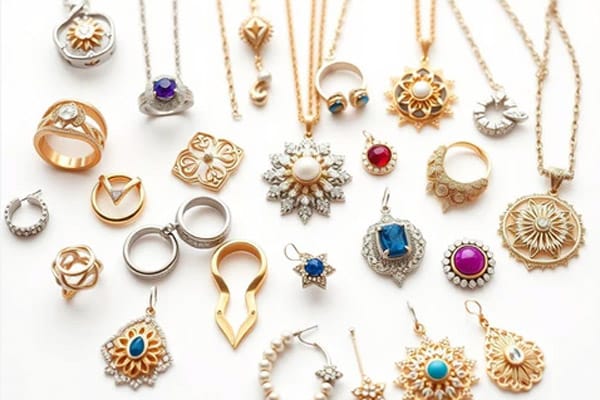
3D Printing jewelry*
Efficiency and Sustainability
Beyond creative freedom, 3D printing enhances efficiency in production. Digital files can be stored, modified and reproduced with ease, reducing lead times. Rapid prototyping speeds up the design process, allowing artisans to quickly visualize and test ideas before committing to final production.
Sustainability is another benefit. Traditional casting methods often involve considerable waste and energy consumption. In contrast, 3D printing uses only the material necessary to produce a piece, significantly reducing waste. Furthermore, the ability to print directly from digital models decreases the need for multiple manufacturing steps, lowering energy usage and emissions.
Challenges and Future Prospects
Despite its advantages, incorporating 3D printing into jewelry making does come with challenges. Material limitations – such as the availability of durable, high-quality printable metals – and the need for specialized equipment and skills can be barriers for some craftsmen. In addition, finishing and polishing processes still require traditional craftsmanship to achieve the desired shine and detail.
Looking ahead, ongoing research and technological advances are expected to address these challenges. Developments in metal 3D printing, such as direct metal laser sintering (DMLS), are expanding the range of materials and improving the quality of printed jewelry. Moreover, the emergence of new post-processing techniques will further enhance the surface finish and durability of 3D printed pieces.
The Future of Jewelry Making
The integration of 3D printing into jewelry is more than a trend; It represents a fundamental shift in how jewelry is conceptualized, designed and produced. As technology continues to evolve, we can expect even greater levels of customization, complexity and sustainability in jewelry creation.
Jewelry designers and manufacturers who embrace these innovations will be better equipped to meet the demands of modern consumers seeking unique, high-quality pieces crafted with precision and artistic integrity. The synergy of traditional artistry and technological innovation promises a future where jewelry is not only beautiful, but more accessible, sustainable and expressive than ever before.
Reference
*Image from https://kingroon.com/