
In today’s rapidly evolving industrial landscape, high-volume manufacturing (HVM) stands at the forefront of global production. To remain competitive and meet the growing demand for quality, efficiency and flexibility, manufacturers are increasingly turning to innovative technologies and strategic development frameworks. This article explores the critical role of technology-driven strategies and process optimization in transforming high-volume manufacturing into a highly agile, cost-effective, and resilient industry.
The Importance of Strategic Development in High-Volume Manufacturing
Market Analysis and Demand Forecasting: Precise predictions of market needs enable manufacturers to plan production schedules, inventory levels, and capacity expansion accordingly.
Technology Adoption: Selecting and integrating state-of-the-art technologies such as IoT, AI, and robotics to streamline operations.
Supply Chain Resilience: Developing flexible supply chains capable of adapting to disruptions, ensuring uninterrupted production.
Sustainability and Compliance: Incorporating eco-friendly practices and ensuring compliance with industry standards.
Process Optimization: The Path to Efficiency
Lean Manufacturing Principles: Eliminating non-value-adding activities to streamline production.
Six Sigma Methodologies: Reducing variability and defects through data-driven decision-making.
Automation and Robotics: Deploying automated systems to perform repetitive tasks with precision and speed.
Real-Time Data Analytics: Utilizing sensors and IoT devices to monitor processes continuously and make immediate adjustments.
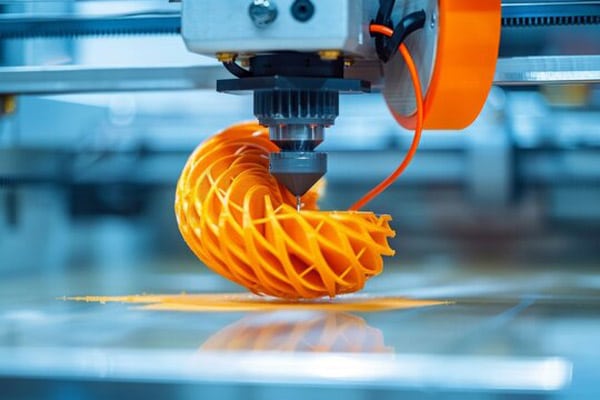
3D printing*
Role of Advanced Technologies in High Volume Manufacturing
Industry 4.0 and Cyber-Physical Systems
Industry 4.0 represents the digital transformation of manufacturing, characterized by interconnected systems that communicate seamlessly. Cyber-physical systems enable machines to autonomously exchange information, adapt to changing conditions, and optimize performance without human intervention.
Artificial Intelligence and Machine Learning
AI-driven algorithms analyze vast quantities of production data to identify patterns, predict equipment failures, and optimize operational parameters. Machine learning models can forecast demand fluctuations, enabling proactive capacity adjustments.
Additive Manufacturing (3D Printing)
While traditionally used for prototyping, additive manufacturing is now being integrated into high-volume contexts for producing complex components with minimal waste, enabling rapid customization and reducing lead times.
Advanced Robotics and Cobots
Collaborative robots (cobots) work alongside human operators to perform repetitive or hazardous tasks, increasing safety and productivity. Autonomous Guided Vehicles (AGVs) facilitate material transport across manufacturing floors.
Digital Twins
Creating virtual replicas of physical manufacturing processes allows engineers to simulate changes, optimize workflows, and predict potential issues before they impact real-world operations.
Nanotechnology and Material Innovations
The development of new materials with superior properties enhances product performance and durability, aligning with high-volume demands for quality and innovation.
Implementing a Technology-Driven Strategy
Assessment and Planning: Evaluate existing processes and identify areas for technological integration.
Investment in Infrastructure: Upgrade facilities with IoT sensors, cloud computing capabilities, and automation systems.
Workforce Training: Equip employees with skills to operate and maintain advanced equipment.
Continuous Improvement: Establish feedback loops to monitor performance and incorporate iterative enhancements.
Conclusion
Strategic development and process optimization, underpinned by cutting-edge technologies, are essential for high-volume manufacturing to thrive in a competitive global market. Embracing Industry 4.0, AI, robotics and digital twin technologies enables manufacturers to enhance efficiency, reduce costs and achieve higher product quality. As technology continues to evolve, those who adapt proactively will secure a decisive advantage in the future of manufacturing.
Reference
*Image from https://stock.adobe.com/