
Aluminum extrusion is a versatile manufacturing process for creating long profiles with a consistent cross-section. From structural frames and heat sinks to rails, enclosures, and custom components, extrusion can combine multiple features into one part. Good design for manufacturability (DFM) helps make those profiles easier to produce, stronger, more cost-effective, and simpler to finish and assemble.
How Aluminum Extrusion Works
The process begins with a heated aluminum billet. A press forces the billet through a shaped die, producing a continuous profile with the die’s cross-section. The extrusion is then cooled, stretched to straighten it, cut to length, and—if required—heat-treated or finished.
Because the die determines the profile’s cross-section, extrusion is especially effective for parts that maintain the same shape along their length. Features such as grooves, channels, ribs, and hollow sections can often be built directly into the design.
1. Keep Wall Thickness Consistent
Uniform wall thickness helps aluminum flow evenly through the die. Large thickness variations can create uneven flow, dimensional distortion, surface defects, or added tooling complexity.
Where possible, use similar wall thicknesses throughout the profile. If a transition is necessary, make it gradual rather than abrupt. Very thin walls may be possible, but they can be harder to extrude—especially in large or complex profiles. The appropriate minimum thickness depends on the alloy, profile size, and geometry, so confirm it with your extrusion supplier early.
2. Use Ribs to Add Strength Efficiently
Ribs can improve stiffness without making the entire profile thicker. They are often useful in panels, channels, and structural sections.
Avoid making ribs excessively tall, thin, or closely spaced. Such features can be difficult to fill consistently and may increase the risk of distortion. Rounded rib roots and tips are generally more practical than sharp corners and can also reduce stress concentrations in the finished part.
3. Design Hollow Sections Carefully
Hollow profiles can reduce weight and integrate enclosed spaces into a single component. However, they usually require more complex dies than solid profiles. Some hollow shapes need specialized tooling, which can increase die cost and maintenance requirements.
Use hollow sections only where they provide a clear benefit. Keep internal walls reasonably uniform, avoid unnecessarily complex cavities, and discuss enclosed or multi-chamber designs with the supplier before finalizing the profile.
4. Add Radii Instead of Sharp Corners
Sharp internal corners can restrict metal flow and create stress concentrations. Adding radii generally supports smoother extrusion and improves the durability of the finished part.
Use the largest practical radius that fits the design. External corners can also benefit from modest rounding, particularly where the profile will be handled, assembled, or exposed to impact.
5. Choose a Suitable Alloy and Temper
The alloy affects strength, corrosion resistance, extrudability, surface appearance, and finishing options. Common extrusion alloys include 6063, often selected for its surface finish and ease of extrusion, and 6061, frequently used when higher strength is required.
Temper describes the material’s condition after processing and heat treatment. The right alloy and temper depend on the part’s loads, environment, dimensional needs, and finishing process. Consult your supplier rather than choosing based on strength alone.
6. Set Realistic Tolerances
Extruded profiles naturally have dimensional variation. Tight tolerances may require more precise tooling, additional inspection, or secondary machining—all of which can increase cost and lead time.
Identify which dimensions are critical to fit or function, and allow looser tolerances elsewhere. For mating features, consider whether a small design adjustment, clearance, or post-extrusion machining operation would provide a more reliable result.
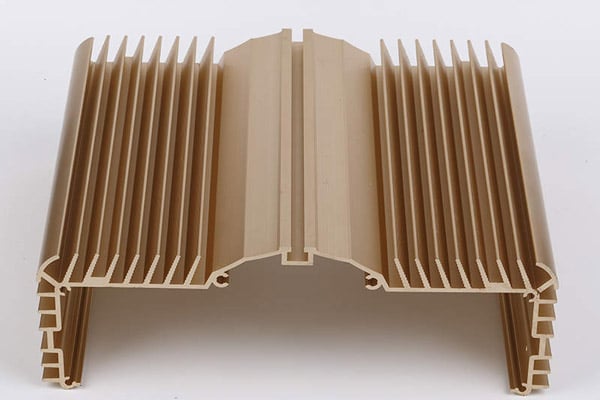
Aluminum extrusion parts*
7. Consider Die Cost and Profile Complexity
A simpler profile generally means simpler tooling, easier production, and lower cost. Every additional feature can affect die design, metal flow, extrusion speed, and maintenance.
Before adding a groove, slot, or small detail, ask whether it can be created during extrusion or would be more economical as a secondary operation. For a new design, a supplier’s early review can reveal opportunities to simplify the profile without sacrificing performance.
8. Plan for Finishing and Assembly
Extruded aluminum can be anodized, painted, powder coated, or left unfinished, depending on the application. The selected finish may affect dimensions, appearance, corrosion resistance, and electrical properties.
Design features should accommodate the finishing process. For example, deep recesses may be harder to coat uniformly, while sharp edges can produce thin or uneven finishes. Also consider how the profile will be cut, drilled, machined, joined, and assembled. Adding access for fasteners or simplifying connection points can reduce downstream work.
9. Account for Straightness and Distortion
Extrusions may bend or twist during cooling, stretching, cutting, or heat treatment. Long, thin, or asymmetric profiles can be particularly sensitive.
Balanced geometry can help reduce distortion. If straightness or twist is important, specify the requirement clearly and discuss achievable limits with the supplier. The profile’s length, shape, alloy, and temper all influence what can be maintained economically.
10. Collaborate with the Supplier Early
A manufacturer can assess whether the profile is practical for the selected press, alloy, and production volume. Early collaboration is especially valuable for hollow profiles, thin walls, tight tolerances, and cosmetic surfaces.
Share the intended application, loading conditions, operating environment, finish, critical dimensions, and expected production quantity. This information helps the supplier recommend suitable geometry and processing options before tooling is committed.
Common DFM Mistakes to Avoid
- Using sharp corners where radii would work
- Creating large, abrupt changes in wall thickness
- Specifying tight tolerances on every dimension
- Adding complex features without checking their tooling impact
- Choosing an alloy based only on its strength
- Ignoring finishing, machining, or assembly requirements
- Waiting until the design is complete to consult the extrusion supplier
Conclusion
A well-designed aluminum extrusion balances function, manufacturability, and cost. Consistent walls, practical radii, carefully planned hollow sections, realistic tolerances, and early supplier input can improve quality while reducing tooling and production challenges. By considering the full manufacturing and assembly process—not just the profile’s shape—designers can create aluminum extrusions that perform reliably and are easier to produce at scale.
Reference
*Image from https://www.aixihardware.com/